Features
The Cosmos ’Jersey guys, Giuseppe Rossi and Jose Angulo, embrace the challenge
It makes perfect sense that a couple of Jersey guys, Giuseppe Rossi and Jose Angulo, are at the forefront of the return of the New York Cosmos as a Paterson, NJ-based, community-driven club that will begin play in USL League One in 2026.
“Knowing the Cosmos ’history in New Jersey and being from [Clifton], it’s about bringing back a historic name—building the team, the brand—the way we want to and get it back to where we should be,” Rossi said.
“I’m part of a phenomenal team,” he continued. “To do this now, being the Vice Chairman and Head of Soccer, knowing players that came before me, what they represent and what they did for the game of soccer in this country—it’s a big responsibility and I’m happy to have it. The pressure is on. I know the pressure. It’s what my life is about. It’s nothing new to me, which is making it easier to go about this work.”
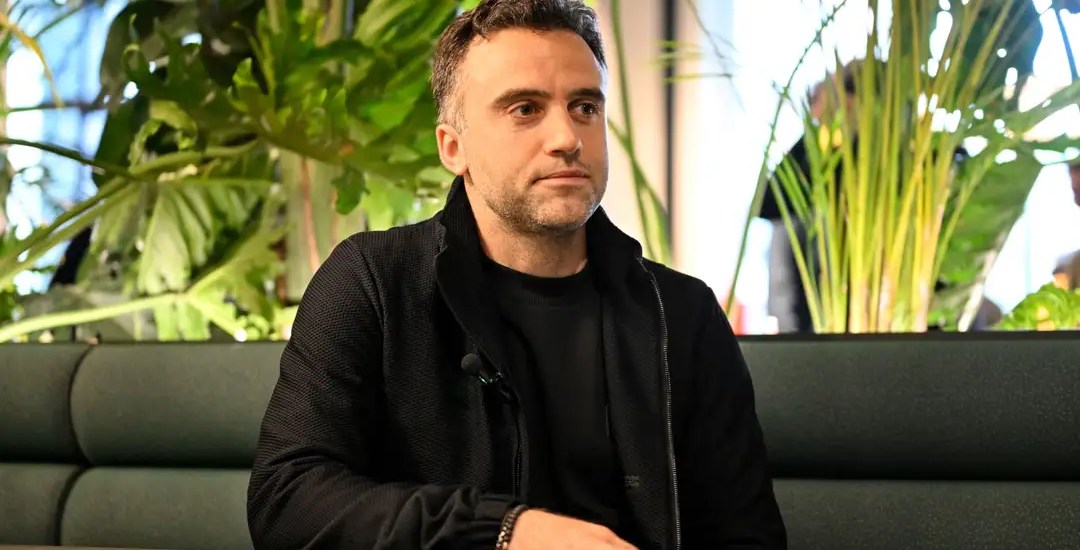
Rossi, 38, played high school soccer in Clifton where his father, Fernando, was the long-time coach. The Rossis moved to Parma, Italy, when Giuseppe was 12 years old to be part of Parma AC’s youth program. He went on to spend time in England (Manchester United and Newcastle United), before playing the lion’s share of his career in Spain with Villarreal (136 appearances, 54 goals) and in Italy with Fiorentina (34 games, 16 goals). He also played internationally for Italy at nearly every age level, including in the 2008 Summer Olympics, and earned 30 senior caps with the Azzurri.
Rossi’s vision, which is shared by Angulo, the club’s Scout and Manager of Youth Partnerships, is to build a squad from the ground up between now, the start of training in January and the inaugural League One season at historic Hinchliffe Stadium, hard by the Great Falls in Paterson.
“I want to build a team that’s young, [so] that we’re able to help develop these young kids and just give them this platform they so desperately want,” Rossi said. “I don’t want to sacrifice development of players in the first years. It’s very important to create a competitive atmosphere and a winning culture. It’s something I will be adamant about. It’s not only about you the player—it’s about the club, the teammates. I’ve been down this road. I know what it takes. It’s nothing new to me and it’s important to share my knowledge of the game and hopefully we’re able to develop a platform here.”
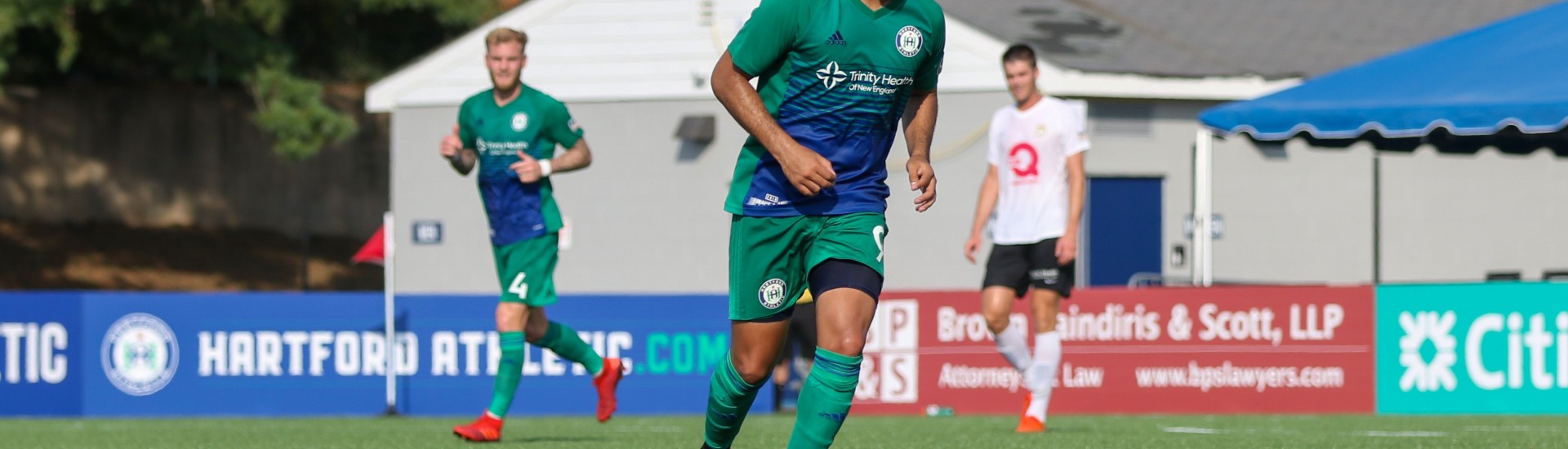
Angulo, 37, is a Paterson native who grew up playing for a club (Colso) founded by his late father José, in Pennington Park along with other immigrants from Colombia. He went on to play in high school at St. Benedict’s Prep and had a long professional career with many stops along the way—none more interesting than the time he spent playing for the Pittsburgh Riverhounds in the USL Championship. That club, for which Angulo played 47 games and scored 23 goals, recently announced a plan to expand its riverfront Highmark Stadium.
“I scored the first goal in Highmark,” Angulo said about the 5,000 seater that opened in 2013. “It was a team and a place that took me in after my first stop with the Red Bulls [in 2012]. They gave me an opportunity to show my skill. In my first game, I came on as a sub in the second half and on my first touch I scored my first goal there.”
Now as the Cosmos lead scout, Angulo said that he’s compiled a database of New Jersey-based players that includes “hundreds” of names.
“I came on the team officially at the end of July,” Angulo said. “But my process mentally started when I had my first contact with the Cosmos. I already had some players I had seen and tracked. I started preparing six months ago.
“I have a bit of an obsession,” he added. “I watch games, wanting to know what players are out there and I wanted to be ready. I knew at some point my work could be put to use. I’ve always been prepared … where the game is, the league, how the structure is going to change [with promotion and relegation coming to the USL]. So I started to prepare, watching games all over New Jersey in the UPSL, NPSL, USL Two, MLS Next, USL One, USL Championship and NISA. I’ve gone to some other states to check out some games. That’s the process.
“The job that never stops. You always need a database of players you can plug into, being ready with players year round. It’s a process that takes a long time, understanding the identity of the club and the type of players Giuseppe wants. There’s so many players in North Jersey, New York and surrounding states in a 50-mile radius. So many players, so many to look at—guys who may have fallen through the cracks. There are good players in this area.”
The work has already begun, with a series of local tryouts designed to put together a group of young men who may know the Cosmos only from historybooks and old, grainy videos, but who are proud to wear the Cosmos’ name on their custom Capelli jerseys.
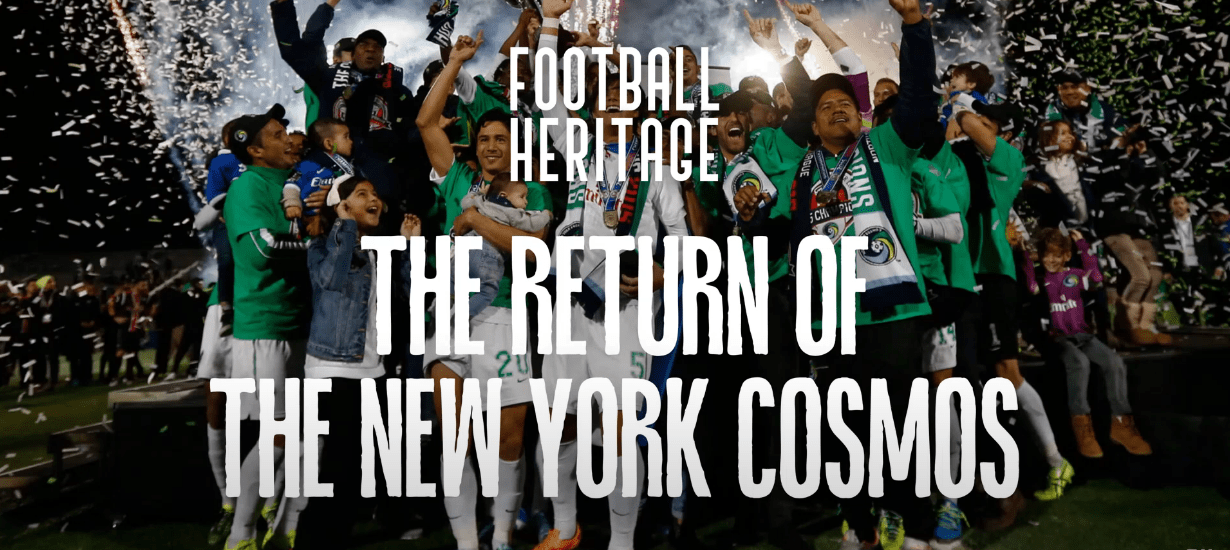
VIDEO: THE FOOTBALL HERITAGE PODCAST — THE RETURN OF THE NEW YORK COSMOS
Q&A: COSMOS SCOUT AND MANAGER OF YOUTH PARTNERSHIPS JOSE ANGULO, A PATERSON PRODUCT AND FORMER USL MVP
Before traversing the country during a 13-year pro career, before earning USL Pro MVP honors, and even before winning national titles at St. Benedict’s Prep and emerging as a U.S. U-17 national team prospect, Jose Angulo had developed a rare perspective on American soccer’s depth and potential.
That came thanks to a childhood spent watching neighbors and former pros contest lively Sunday league matches at Paterson’s packed Pennington Park. And it came playing for Colso Club, the team launched by Angulo’s late father, long-time pro José Angulo, and fellow Colombian immigrants who noticed a dearth of opportunities for young players in urban New Jersey.
“It was a very interesting time to grow up as a soccer person,” Angulo said. “You had to go search for it, or make it yourself.”
Angulo, now 37, made it pretty far. As a child, the Barranquilla, Colombia-born striker moved to Paterson’s 21st Ave. neighborhood and attended PS No. 30 (Dr. Martin Luther King, Jr. Educational Complex). He eventually spent time with the New England Revolution and New York Red Bulls and played for teams in the USL, NASL and NISA.
A professional high point was winning the 2013 USL Pro MVP award after scoring 15 regular season goals for the Pittsburgh Riverhounds. But there also were times when Angulo felt like he’d slipped between the cracks. Early passport and paperwork issues prevented a move to Europe and cut short his dream of representing the USA in the 2005 FIFA U-17 World Cup. And occasionally it seemed like his non-traditional developmental path wasn’t always embraced at the highest levels of the domestic game.
Angulo’s unique journey through the promises and pitfalls of the sport’s American ecosystem, not to mention his strong ties to North Jersey’s diverse soccer community, made him the ideal choice when New York Cosmos Head of Soccer Giuseppe Rossi was looking to make his first technical appointment.
In July, Angulo was hired as the club’s scout and manager of youth partnerships. The Cosmos, who will kick off their USL League One schedule in March 2026 at Paterson’s renovated Hinchliffe Stadium, are dedicated to identifying, signing and fielding local athletes. Angulo will be the point person for finding those players and forging fruitful relationships with nearby clubs and coaches.
It’s a fitting position for someone who once navigated that complex terrain, and who still believes there’s loads of untapped talent throughout North Jersey and the Tri-State area. It’s also an appropriate landing spot for someone who appreciates the Cosmos’ legacy. Angulo’s father, José, remained Colombian at heart yet still revered the great Pelé. Dad and son would subject their VHS recordings of Brazil’s World Cup highlights to heavy use. So the Cosmos’ return to competition, and their commitment to offering opportunities to local players, represents a gratifying full-circle moment.
“It’s surreal that Pelé was involved with the Cosmos, and now I’m working for the Cosmos. I wish I could share it with my Dad. It’s an honor,” Angulo said.
“I know how big this is. I know how much this means to the kid who’s in school right now from Paterson and thinking about soccer and thinking, ‘I have to leave to play,’” he continued. “To have it close to home, that’s opportunity. That’s hope. For a young player, there’s a chance for me to learn here, be a pro here and then from there, maybe go to Europe. It’s a pathway that has never existed here, and it’s going to be something special.”
Angulo ended his playing career in 2021 and 18 months ago, he helped organize (and coach) an exhibition match between an ad hoc team of local players and traditional Ecuadorian powerhouse Barcelona SC. The match attracted thousands to Hinchliffe, demonstrating locals’ love for the game and the venue’s soccer potential, not to mention Angulo’s administrative acumen. He’ll now be charged with funneling players toward Hinchliffe full-time.
Angulo is already on the job, scouting and identifying potential prospects while strengthening the sort of personal and organizational relationships that create genuine community and opportunity. In early August, he took some time to answer a few questions about his new position and his hopes and plans for the Cosmos as the 2026 season approaches.
What inspired you to take this position with the Cosmos and to dedicate your post-playing career to this kind of work?
JA: I’d like to think that all of these things that I’ve seen and been through starting from a young age kind of led to this. There’s a formula that’s been common around the world for 100 years. You go to South America, and it’s the normal way of doing things: you find young players from your town, your area, and you build them up.
But here in America, it’s like they’ve gone the opposite route. You want to get the two or three big stars, and that’s how you’re selling out games but you’re not connected as much to the community. With what we’re doing here, it’s something that’s never really been done before in this country: a team of mostly local guys and a lot of talented players in the area who have fallen through the cracks. I think my job is identifying those guys that aren’t getting a chance but can maybe compete at that level. It’s to help the team win and compete, but also stay financially stable.
Can you tell us more about how you’ll tackle the role?
JA: We’re going to scour the Tri-State area for players, from the age of 14-15 to the pro level. If you’re good and you’re in the area, we’re most likely going to see you at some point. It’s a mixture of leads and conversations, but it’s also just going to games. For example, I was able to go to some NPSL and UPSL games this summer, and I’m the only one there. I’m the only one watching these players at this level. There’s no scouts, nothing.
It comes to a point where these players, people just stop looking at them. Even if you look at MLS Next, where you’ve got younger players, all you see is college guys there. So it’s a wide-open market that’s not being explored. I’m out here by myself just sitting at these games. Nobody knows who I am. It brings me back to being young and my Dad saying, “You don’t know who’s watching.” I’m that guy now. I’m the one watching. It doesn’t matter the level. I’ll stumble onto a game at a park and I’ll watch. You never know.
It’s using all avenues. There’s no one way. Sometimes I do research on a guy to see what’s up. Sometimes I get in the car. I’ll get in touch with someone the player knows to see about their character, their personality. I’ll have somebody I trust give me feedback. Or I’ll get in my car and go see them in person. It’s a bit of everything.
Why isn’t this a more common approach?
JA: It’s a bit old school. Wyscout isn’t going to find you this player. You need to be in an area where there’s talent that nobody’s really watching, and I would say you need expert eyes. It takes an understanding of the landscape—understanding what the game is here, and also filtering out the money grabs.
There’s a lot of pro combines. Is there really talent there, or is it whoever pays the $150 for two days? It’s knowing the landscape and filtering out who’s doing it right, who’s doing it wrong, and getting into these communities—literally on the ground in these communities and the inner city. There’s players there, and we’re trying to do something in this area that nobody’s done before.
It obviously helps to have grown up here. A lot of the guys I’m meeting with who run this club or that club, they’re all guys I know about or I’ve seen before. I’m coming in with these existing contacts and then strengthening them.
How will this ultimately shape the squad that finally takes the field next year?
JA: It’s about finding the right balance of players who can help you in the now, but also kind of giving knowledge to these young players coming up. You don’t want young players playing against young players every day, because who’s learning from who? It’s finding a balance between more experienced pros in the area—and they’re here—just identifying those guys and bringing in a balanced roster to help these young players as well.
Eventually one or two can get sold here, sold there. I think that’s down the line. For now, it’s just identifying a lot of guys this year. These things take time.
To wrap up, can you share your best, only-in-North Jersey soccer story?
JA: It was my first day of school at St. Benedict’s. This is my freshman year. My father tells me that one of his former teammates from Colombia wants to put his son in school in New Jersey, so he’s here in Jersey and we’re going to show him the school.
When I get in the car I see a guy with all this hair and it’s like, is this guy wearing a Valderrama wig? He turns around and it’s Carlos Valderrama! And yeah we walked into St. Benedict’s Prep, which is like an old school, inner-city school. It’s all brick and in the middle of Newark. It’s kind of like Paterson—very similar city. And Valderrama walks in and you see all the soccer players from St. Benedict’s just turn around and say, “What?” That was a fun story.
FIFA.COM — ROSSI ON HIS NEW YORK COSMOS VISION, ITALY AND 2026 BUZZ
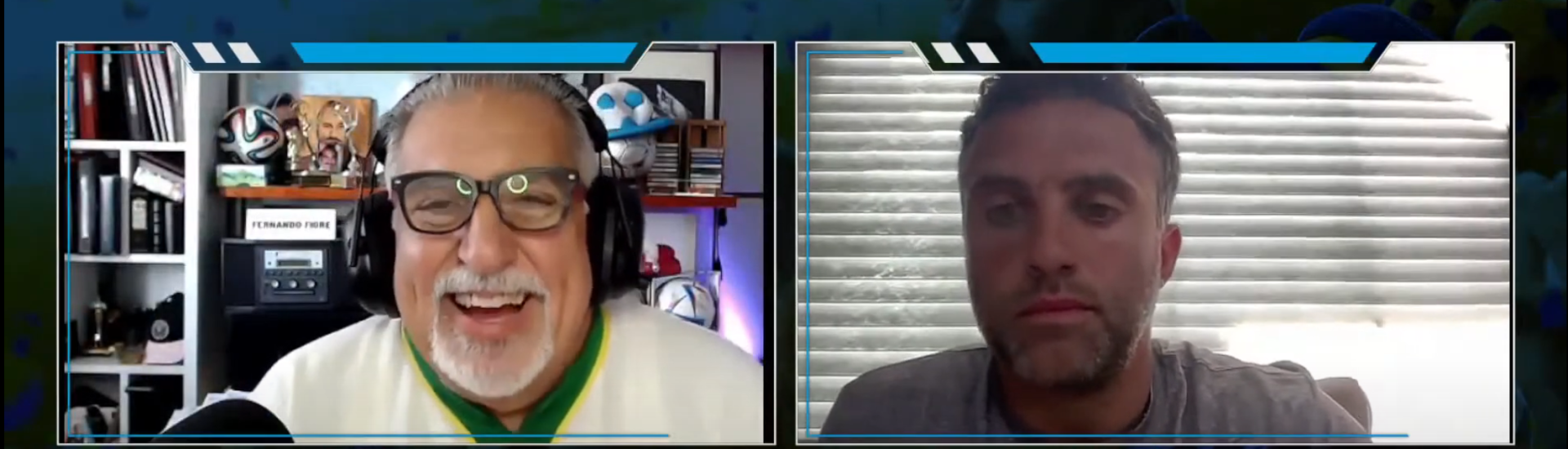
VIDEO: REPÚBLICA FÚTBOL — GIUSEPPE ROSSI EN EXCLUSIVA
VIDEO: BECAUSE FOOTBALL — The NEW Cosmos: Talent Development & Community Engagement
Messing recounts return to Cosmos in 1976 and that famous photo

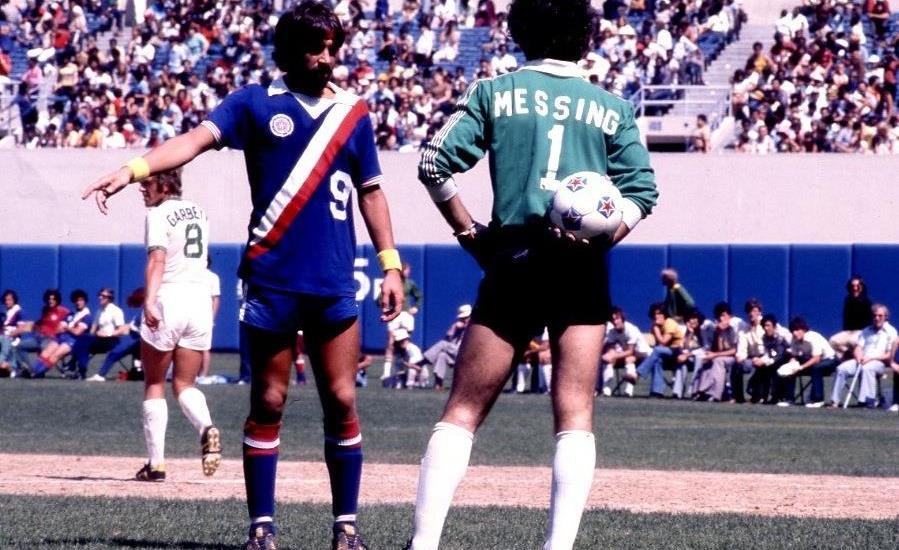
The photo is iconic. It’s probably the most famous image of the 70’s era Cosmos not including Pelé, Chinaglia or Beckenbauer. There’s so much to take in – the colors, the attitude, the backdrop of Yankee Stadium. But, what’s the backstory?
We sat down with Shep Messing to find out.
“I love that picture,” Messing said with a grin.
Messing spent the 1973 and 74 seasons in New York but moved to the Boston Minutemen prior to the 1975 season. That year he led the North American Soccer League with a 1.24 goals-against average. As he was enjoying his time in New England, the Cosmos made huge international news – Pelé was coming to the Big Apple.
“I pick up the paper and Pelé just signed with a Cosmos, so I’m like, ‘You got to be kidding me,'” Messing said. “If I didn’t screw up, I’d be on the team with Pelé.”
Messing would soon join ‘O Rei,’ but it would take one life-altering match to make it happen.
On June 16, 1976, the Cosmos and Pelé would host Messing’s Minutemen at Yankee Stadium. It was a back and forth affair with both Messing and Cosmos keeper Bob Rigby standing tall. With regulation time coming to an end with a score of 2-2, the match went to a penalty shootout to decide the winner.
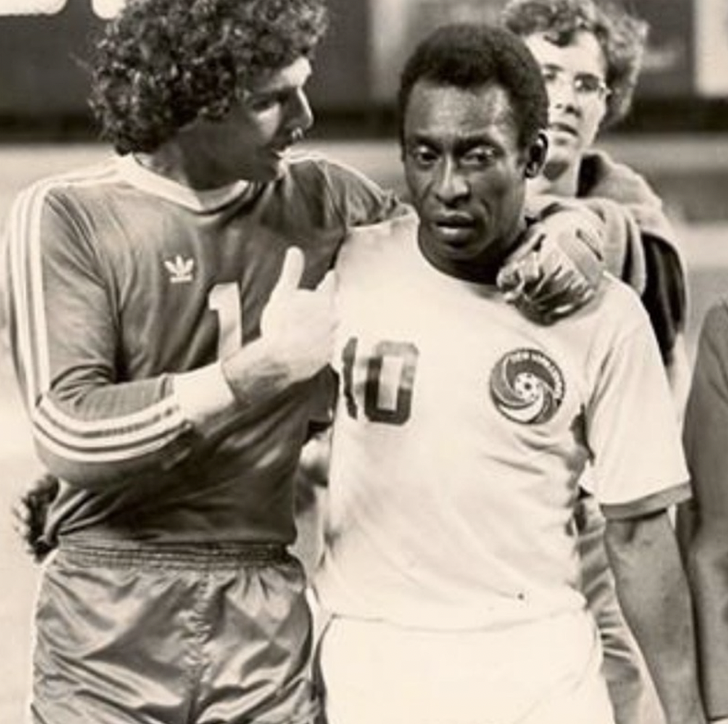
It went back and forth in the shootout including the total chaos of Minutemen players going out of order with the referee allowing a restart. The ultimate result turned when Pelé lined up for the Cosmos. Messing guessed right and Pelé’s shot caromed off the woodwork. The Cosmos would protest the result to no avail, but the match left a lasting impression on the World’s greatest player. Afterwards, Messing was seen consoling Pelé in another famous Cosmos photograph.

Later that month, Bob Rigby would find himself sidelined for the rest of the season – with notorious, hard-nosed Washington Diplomats striker Paul Cannell barreling into Rigby on a corner kick. Rigby would break his collarbone on the play, and the Cosmos would lose the match, 3-2.
Cannell, who scored twice, told the Passaic Herald-News: “I’m a dirty SOB. I’ll do anything to get the ball in the net. I felt a bit bad when I saw him shaking on the ground but then, I was punched in the first half. I was getting even.”
The news reached Messing quickly. “My brother-in-law was watching the game,” the goalkeeper said. “He calls me in Boston, and he says Bob Rigby just broke his collarbone. I don’t do anything – I’m just pissed off. You feel bad for the guy and goalkeepers stick together.”
The Cosmos, without their starter, needed a goalkeeper, desperately.
The Minutemen – in the middle of a fire sale to steer the club through financial difficulties – needed money, desperately.
So, a deal was struck.
“From what Pelé told me later, he went to Steve Ross and said, ‘get us the guy from Boston’,” said Messing.
“The Minutemen were getting on a flight to go to Seattle, and the owner there was going bankrupt. We used to try and get paid from the hot dog stand guy,” laughs Messing. “So, I’m at Logan Airport with the team ready to fly to Seattle, and [Head Coach] Hubert Vogelsinger sitting there calls me over and he says, ‘You’ve just been traded to the Cosmos for 22 plane tickets, round trip to Seattle.'”
Upon his arrival in New York, Messing met with Rigby – friends before the trade – and made a promise to his fellow member of the “goalkeepers’ union.”
“I’m going to get him for you, pal.”
Messing’s arrival sparked a six-game winning streak for the Cosmos that set-up a rematch at Yankee Stadium with Paul Cannell at center stage. True to his word, Messing found the proper moment to make his presence felt.
“The first time I have an opportunity. I had the ball in front of me,” he said. “Cannell was 10 yards away. So, I held that ball out in front of me. I said, ‘Come get it.’ When he stepped up and he came towards me I put the whole ball behind my back. I drew him to me. I said, I’m gonna [expletive] you up.’ He put his right arm out and said, ‘Well, what are you talking about, mate?’ I said, ‘You did Rigby. I’m going to [expletive] you up.”
And thus, the photo was taken.
“So, you can see why I love that picture,” grinned Messing, again.
Cannell steered clear of Messing the rest of the match, as the Cosmos routed the Diplomats, 5-0.
Cannell would meet the Cosmos one more time that season – warning them in the New York Daily News that “No prisoners will be taken” prior to the first round of the NASL playoffs at Shea Stadium in August. Messing had the last laugh, though – blanking the Diplomats 2-0, and leaving Cannell with only nine fouls to show for his efforts.
“Hey, if he can get other goalkeepers to lose it, that’s cool,” Messing said that season. “But he can’t intimidate me. No way.”
Especially when you’re a card-carrying member of the goalkeepers’ union.
Shep Messing backstopped the New York Cosmos to victory in the 1977 Soccer Bowl, Pele’s last competitive match. You can hear the latest from the American soccer legend on his podcast, The Shep Messing Daily Cast. You also can follow Messing on Twitter.
A kiss, a crest and five decades of Cosmos continuity — tracing the history of one legendary club
The shape of the tarnish on the trophy’s bowl is unmistakable. It’s a pair of lips—a single kiss perfectly preserved—somehow burned or branded onto the shimmering silver.
Tom Larsen was stunned when he saw it. Because of some slight damage to the base, the Soccer Bowl ’77 trophy wasn’t displayed alongside its counterparts at Mediacom’s New York headquarters. It had been carefully preserved, however, and placed in a climate-controlled storage facility, because the importance of the New York Cosmos’ second NASL trophy also was unmistakeable. It was earned in the great Pelé’s last competitive match, a 2-1 victory over the Seattle Sounders in Portland, Ore.
Although that final was played nearly 50 years ago, it still resonates. So much so that FIFA, as it compiled a wish list for the Miami museum it plans to open before the 2026 World Cup, contacted Mediacom and asked to borrow the trophy.
“They said, ‘We would love to do a space on Pelé and that’s the last trophy he ever won,’” recalled Larsen, Mediacom’s senior VP and general counsel. “That just shows you how important the Cosmos still are and how even internationally, they matter to people.”
Mediacom and its founder and chairman, Rocco B. Commisso, had owned the Cosmos since early 2017. But Larsen hadn’t noticed the tarnish until the trophy was retrieved from storage last winter. It quickly brought to mind a widely-circulated, black-and-white photo of Pelé and Cosmos teammate Werner Roth carrying the trophy upon their triumphant return to JFK Airport. Sure enough, there’s El Rey, front and center in what appears to be a stylish white linen suit, planting an enthusiastic kiss on the cup.
“Clearly, the lips are Pele’s. You can see in the photo, the kiss is in the exact spot,” Larsen exclaimed. “We put it in the contract with FIFA: you can’t polish this! The historic value of the kiss is what makes it unique.”
How did the tarnish happen? What might’ve been on Pelé´s lips? Was it chemistry, or perhaps something less scientific? It’s impossible to know a half century later. But there they are, clearly imprinted on the metal, a genuine American soccer relic. Pelé’s legend, and the lore surrounding that once-in-a-lifetime Cosmos team and a unique era in the domestic game’s meandering history, continues to grow.
A soccer club obviously exists to play the sport. That’s its primary function. But over time, a club often becomes about more than athletes and supporters, wins and losses, tickets and transfers.
We see it every time a goal scorer kisses the badge on their jersey. We see it when fans of teams like Atlético Madrid, Leeds United, the Chicago Fire and so many more fight to preserve a logo that became a symbol of community and shared history. The word “brand” may sound a bit corporate, but consider an original meaning: an identity burned permanently onto something. Crests and colors, history and tradition, old jerseys and trophies that kindle priceless memories—a kiss sealed in silver—these are also vital components of a club, as fundamental as a person’s name.
That’s why so many stewards, from Commisso, Larsen and Mediacom to the renowned Peppe Pinton, have worked so diligently and invested so much to preserve the Cosmos’ brand and legacy. There were years when the Cosmos haven’t played soccer. But from its 1971 founding to its record eighth championship in 2016 and beyond, it’s always been a soccer club.
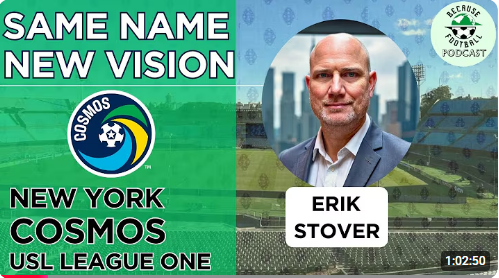
“The continuity of the club is clearly defined,” said Erik Stover, who ran the Cosmos during their NASL 2.0 era and will serve as CEO when they return to the Hinchliffe Stadium pitch in Paterson, NJ, in 2026. “We know who owned the club and when, and all of those people who maintained the trademarks and fielded teams and believed in the ideal of the Cosmos.
“It’s a uniquely American soccer story in that there are big gaps when they didn’t play,” Stover continued. “In the late ‘80s through the early 2000s, Peppe Pinton spent a lot of his own money keeping the dream of the Cosmos alive, keeping the club active by selling merchandise and doing camps and clinics. And that effort has been consistent throughout the last 50 years.”
Pinton, who still lives in Northern New Jersey, was a colleague and friend of Cosmos legend Giorgio Chinaglia. The Italian striker had taken majority control of the club from Warner Communications in 1984, shortly after concluding his glittering playing career. The original NASL then shut down in 1985, and Chinaglia subsequently transferred ownership and control of the Cosmos’ assets to Pinton, then the club’s general manager. Over the next quarter century, Pinton dutifully kept the Cosmos alive, maintaining the trademarks, running his Cosmos Soccer Camps (which still exist) and dreaming of a return to professional play.
“He’s the person that saved the brand from its death,” Larsen said.
Pinton finally parted with the Cosmos in 2011, selling the club to a consortium fronted by English businessman Paul Kemsley. He then sold it to a group led by English sports marketing executive Seamus O’Brien later that year. The American pro soccer landscape had shifted considerably by that point, and the advent of the second NASL ensured the Cosmos could join a league that guaranteed their independence. The stars finally aligned for a return to competition, and the long hiatus ended with a sixth championship in 2013.
The on-field success reflected the Cosmos’ legacy. In Raúl González and Marcos Senna, the club showcased the brilliant and charismatic imports for which it was famous. But with the likes of Carlos Mendes and Danny Szetela, among others, the Cosmos also fielded the sort of local and domestic talent which has always been a critical and treasured part of their identity.
Additional NASL titles were claimed in 2015 and 2016 and multiple MLS foes were vanquished in the U.S. Open Cup. But a club isn’t just players and games, and what transpires off the field matters, too. The NASL was struggling, and the Cosmos, after playing in Nassau County and Brooklyn, still lacked a permanent home.
The Cosmos were running out of time when Commisso, a long-time soccer fan who played for Columbia University in 1967-70, stepped in and purchased the team in early 2017. But when U.S. Soccer stripped the NASL of its sanctioning during the ensuing campaign, the Cosmos were adrift once again.
Apart from a handful of games contested as part of a National Independent Soccer Association (NISA) tournament in fall 2020, the Cosmos haven’t played since. But the club endured. Like his Italian-American compatriot, Pinton, Commisso desperately wanted to see the Cosmos back on the field. But he had to ensure that field was a fair and level one, so he began backing the NASL’s antitrust suit against U.S. Soccer and MLS in fall 2017.
Meanwhile, Larsen and his colleagues have been keeping the Cosmos’ heart beating. Through May of last year, he stayed active on the NISA board while the club remained a dues-paying member. NISA operated as a third division pro league from 2021 through 2024. The Cosmos logo retained its value. International outfitters like Admiral and TOFFS utilized deals with the club to create and sell thousands of branded items, while the Cosmos maintained a local presence through a jersey distribution arrangement with a Westchester County, NY, soccer shop. Larsen led the protection and defense of the trademark against counterfeiters and unlicensed users, and Pinton continued running his Cosmos soccer camps with the blessing of club ownership.
“We did a lot. We were busy. We were really working at building the Cosmos brand and protecting it at the same time. That’s not putting a team on the field, but it was working toward that goal,” Larsen said.
“At the same time, I was always looking for a potential buyer,” he continued. “I didn’t want Rocco’s legacy to be the last owner of the Cosmos. He bought them to save them, to keep the brand alive. In his heart, he wanted the club to play again. But he also didn’t want to put the brand in the hands of someone who started it and then failed. It was important to find an owner that had the business plan in place to make this thing a going concern, that could survive.”
Re-enter Stover, who maintained a relationship with Larsen over the years. Stover, the New York Red Bulls’ managing director before running the Cosmos, returned to New Jersey after a stint in Denmark and reconnected with former colleague Baye Adofo-Wilson, a real estate developer and attorney who had been Deputy Mayor of Newark in 2014-17. Adofo-Wilson, a Paterson native, was spearheading a $110 million project anchored by the renovation and refurbishment of Hinchliffe Stadium, an historic venue that once housed Negro League baseball teams and stood just a few hundred feet from the famous Paterson Great Falls.
“He had the vision that soccer would probably be the most popular sport in the stadium,” Stover said of Adofo-Wilson, now the Cosmos chairperson. “It is the only stadium of its type in the New York metropolitan area and it’s perfectly situated to build a club around.”
Those were the ingredients Commisso and Larsen were seeking—the sort of permanent home and foundation that the Cosmos, despite all their assets, never established. Larsen reached out to Stover in early 2025 and the deal to sell the club to Adofo-Wilson’s North Jersey Pro Soccer group was quickly hammered out. Commisso retained a minority share in the team he rescued eight years earlier.
“We took our time with respect to the team kicking the ball on the field. We took the time to find the right buyer. We found the right buyer. I think Paterson is a phenomenal landing spot—the [current Negro League baseball and future Cosmos] museum, the stadium renovation, the size of the field, the fact it’s got the falls, the view of the New York City skyline,” Larsen said.
“The city is 100% behind this project and they’ve put their money into it,” he continued. ”The fact that Baye is a Paterson native and invested in making Paterson a great city again, and building a club that’s a reflection of the neighborhood and giving kids a place and a pathway, all that stuff is amazing, and that’s why I think we found the right place. But that part took time, and that was continuous with all the other stuff we did to keep the brand alive.”
The museum Larsen mentioned will be constructed at Hinchliffe and will feature some of the thousands of items that Pinton, Stover, Commisso and others have saved across the decades (as well as that 1977 trophy once it’s returned by FIFA). Club museums aren’t uncommon elsewhere. Many understand intuitively that preserving the tangible trappings of the game, and memorializing the players, moments and memories that mean so much to fans and the surrounding community, can be as much a part of the sport as scoring goals. It matters. It creates a thread that can be traced through seasons and generations.
For the Cosmos, the most iconic club and brand in U.S. soccer history, that thread has remained intact from the moment founder Clive Toye conjured the name. There have been twists and turns, triumphs and troubles, but the full realization of the club’s mission now is finally at hand. And it has a home address.
The Cosmos will field a professional women’s team for the first time in the coming years, and with Vice Chairman and Head of Soccer Giuseppe Rossi on board, the club will be committed to developing and promoting local talent once its USL League One schedule kicks off in 2026.
“Cosmos” is short for “Cosmopolitan”, and the brand has always been about uniting diverse people in celebration of soccer. Like Pele’s silver kiss, neither the mission, nor that legendary logo, ever faded away.
“Clive built the club one neighborhood at a time, and he was using soccer to pull different communities together around this club. Part of the club’s legacy is to be diverse and inclusive and that was at the core of the Cosmos when it was founded,” Stover said of Toye and the early ‘70s origins. “We’re doing exactly the same thing.”