Features
THE GUARDIAN — The Cosmos return with a new home, new league and old ideals
Founder Clive Toye on the birth and rebirth of the Cosmos
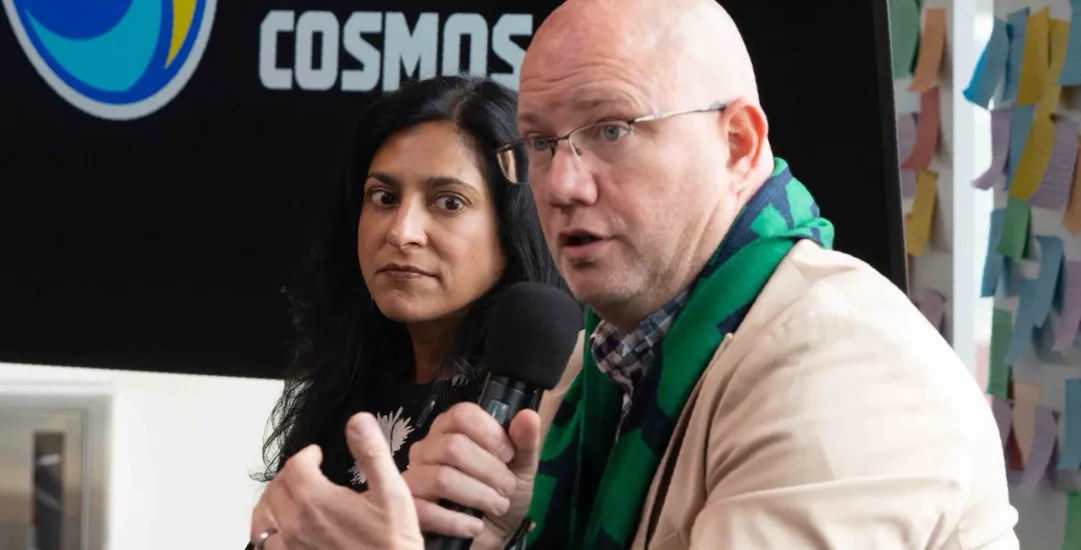
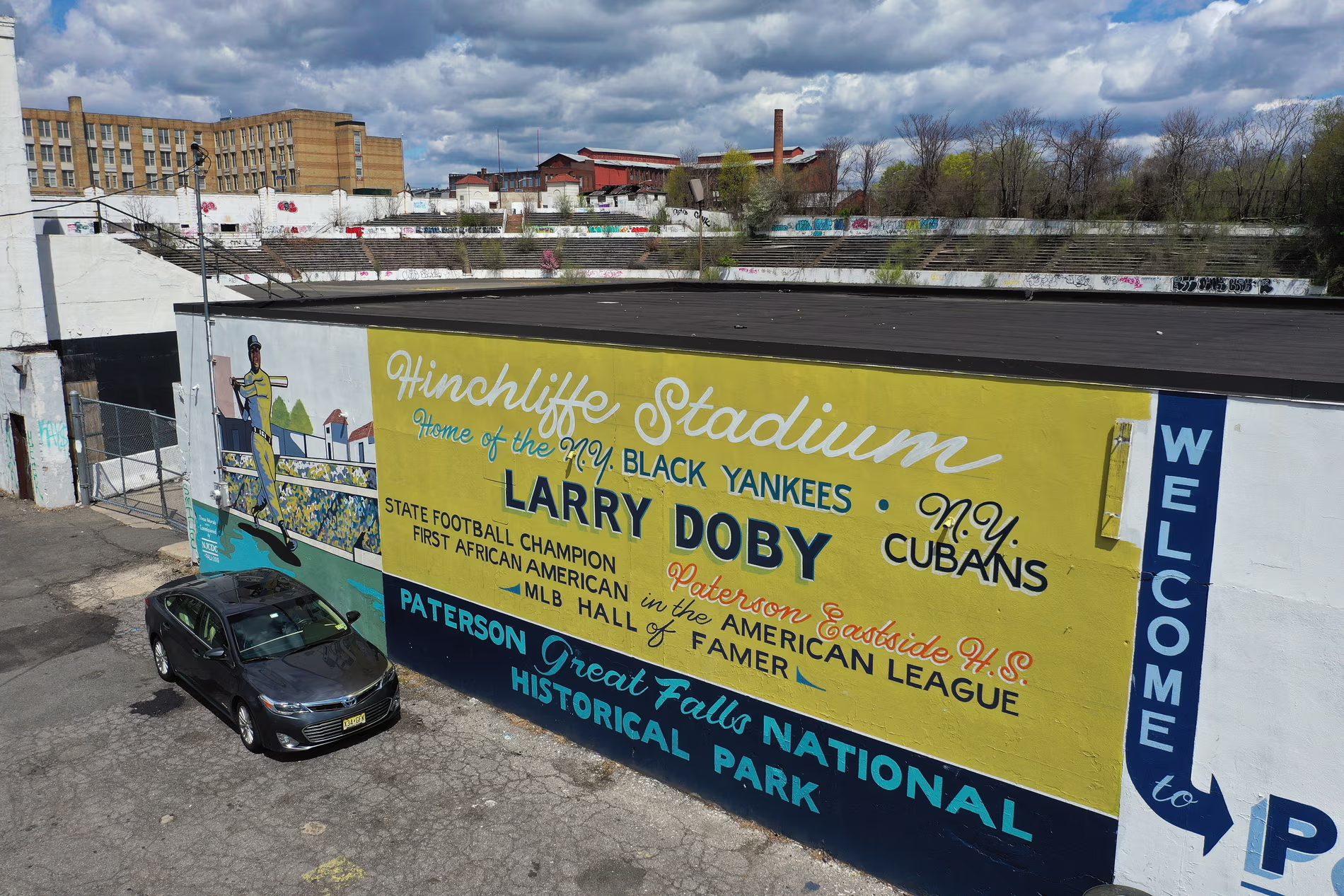
As the founding general manager of the Cosmos, Clive Toye built the club from scratch in 1971. The National Soccer Hall of Famer spoke with Club Historian David Kilpatrick to reflect on those early days and contemplate the parallels as the club prepares for another rebirth. The Cosmos are resuming team operations ahead of the 2026 USL League One season at Hinchliffe Stadium in Paterson, NJ.
What do you recall about the birth of the Cosmos?
Remember that the Cosmos came into existence in January 1971, and our first game was April 15, away at St. Louis, so there wasnt like a huge time of luxury to think about things. At that time when I came here in January of ’71, the Cosmos didnt have a name. I had to create that over the next few weeks!
How did you decide on the name?
I wanted a name which was different. I wanted a name which was big. I went through the list of names in my own mind of the New York sports franchises, and didnt think too much of any of them, but looked to see where I could follow on and be bigger. The most recent—in terms of history—club to come into existence was the Mets, and the Mets was short for Metropolitan.
And I thought, “ can I come up with something which is bigger than that,” and came up with Cosmopolitan. Some other people came up … the Erteguns wanted to call it the New York Blues and somebody else wanted to have the team wear pink uniforms and call it the New York Lovers.
Really? Oh my God!
Oh yes. So I thought Cosmopolitan, no good. Cosmopolites, thats no good. But Cosmos, that is great. Its a derivation of Cosmopolitan and what is New York other than cosmopolitan? And what is bigger than the cosmos? Nothing, so thats what well be. And then I had the problem of convincing the ownership that that was the name so I got a competition going, and at that time I had certain relationships with people at Swissair and got them to come up with two free tickets from New York to Switzerland for the winners of the competition for the name of New Yorks newest professional soccer club.
Then, [we] had the competition and you can imagine, you know, we didnt get that many entries cause we didnt get that much publicity. This was January of 1971. So I wrote a lot of letters to myself with different names and addresses proposing the name the Cosmos and then, thank God, I remember the mail, opening a piece of mail, and I was at a board meeting of the [U.S. Soccer] Federation in New York and I picked up the mail and went into the meeting. It was the opening of the meeting and there, I remember Gene Edwards looking at me and saying to me, “ chance of you paying attention to the meeting now?”
Opened the mail and there were two high school teachers in Queens who came up with the name the Cosmos. So now I had two real people to whom I could give the trip to Switzerland, and another 20-30 people—whose handwriting looked suspiciously like my own—proposing the Cosmos and could therefore could go to the ownership and say, look, this is it, the Cosmos. So that is how the name the Cosmos came about.
And voila, the greatest name in the history of sport was born.
How do you feel about the Cosmos rebirth in Paterson?
It is truly wonderful to see what is being done to bring the Cosmos back to life again. We were astonishingly good in the early days. … But now the effort is being done to build it back, and build soccer back in the same way. And so, my encouragement for them is more as it can be. If I wasn’t quite so past it, I’d be applying for a job to go back and start running the place to help them build the whole thing again.
JASON DAVIS —Cosmos 3: Back To Jersey

Home Sweet Homes: The Cosmos’ five-decade journey through New York and New Jersey
The Cosmos have called ten stadia and two arenas home since the club’s inception in 1971.
Although Yankee Stadium in the Bronx was home for the Cosmos’ inaugural season in 1971, the club’s home debut was made at Hofstra: an exhibition on April 28 against the Eastern College Coaches Association Senior All-Stars. The Cosmos were scheduled to play their 12 regular season matches at Yankee Stadium, but the baseball tenants reserved the right to veto any game due to weather just hours before kickoff. Six games were postponed.
One 1971 game was moved to Roosevelt Stadium in Jersey City, NJ. It was a 3-1 win over the Dallas Tornado that opened a doubleheader capped by Bologna v. West Ham United, and which drew a crowd of 9,000. That game in Jersey City attracted the second-largest home crowd that year, after 19,739 showed up in the Bronx for a match against the Rochester Lancers. But that also was a doubleheader. It included a friendly between Deportivo Cali and Santos that featured future Cosmos talisman Pelé as the star attraction.
Since Yankee Stadium had proven less than hospitable that inaugural season, when the Cosmos played their first home playoff game on Sept. 5, they opted to host at Hofstra.
Hofstra served as home for NASL games in 1972 and 1973, and it would also serve as the Cosmos’ training ground from 1972 through 1976. Since the size of Hofstra Stadium at the time wasn’t large enough to accommodate the club’s long-term ambitions, club owner Warner Communications tried unsuccessfully to secure the Singer Bowl in Flushing Meadows as a soccer stadium and concert venue. When that fell through, the club decided to renovate Downing Stadium on Randall’s Island—or Drowning Stadium on Vandal’s Island as it was called—in the East River. The Cosmos played there in 1974 and 1975.
After two seasons at Downing, the Cosmos went back to the Bronx for the 1976 NASL regular season at Yankee Stadium. It was unavailable for the playoffs that year, however, so Shea Stadium was home for a day on Aug. 17.
In 1977, the Cosmos moved west of the Hudson River into Giants Stadium at the sparkling new Meadowlands Sports Complex in East Rutherford, NJ. The Cosmos also made Giants Stadium their full-time training facility, leaving Hofstra, where they had trained since 1972. Although some in the organization feared playing at a venue that couldn’t be accessed by train, when 77,691 fans gathered to witness the Aug. 14, 1977 playoff game against the Fort Lauderdale Strikers—setting an NASL attendance record—the arrival of Cosmos Country was confirmed. For 70 consecutive home games of NASL play, the Cosmos drew crowds of 30,000 or more. The streak ran from 1977 to 1981.
In addition to Giants Stadium, Meadowlands Arena served as home for the 1981-82 indoor season. Skipping a year before returning indoors, the Cosmos split their 1983-84 indoor games
between Brendan Byrne Arena and Madison Square Garden. Although arenas in upstate New York and Connecticut were considered for the 1984-85 Major Indoor Soccer League season, the club remained at the Meadowlands for its last indoor campaign.
The last league match played in New Jersey was at the Meadowlands Arena on Feb. 19, 1985. The Cosmos broke a five-game losing streak with a 10-6 win over the Kansas City Comets with four goals from Mark Liveric and a hat trick from Angelo DiBernardo, along with goals from Dragan Vujović, Robert Meschbach and legendary Brazilian defender Carlos Alberto.
Although the club planned 15-18 friendly matches for 1985 at Giants Stadium, only three were played. The last was a 2-1 loss to Lazio on June 16 that ended in a rain-drenched brawl.
A Cosmos Reunion match was held at Giants Stadium on July 21, 1991. A crowd of 31,871 supporters turned out to watch two squads of 52 Cosmos alumni compete in a doubleheader. The Cosmos lost 5-0 to a squad of Italian masters and played to a 0-0 draw against a similarly composed Brazilian select side.
The New York Cosmos’ return to competitive play at Shuart Stadium on the campus of Hofstra University in Hempstead, NY, on Aug. 3, 2013 was truly a homecoming. It marked a return to the site of so much of the club’s early history, and to the only one of its prior outdoor home stadia still standing. Before moving to the Meadowlands in 1977, the Cosmos used Hofstra as their training facility. But in 2013-2019, Mitchel Athletic Complex in nearby Uniondale, NY, was used for that purpose. When the Cosmos claimed their seventh title in 2015 with a win over the Ottawa Fury at Shuart—the same venue at which they won their first back in 1972—a fantasy was fulfilled for long-time Cosmos supporters.
The nostalgia trip in Hempstead was a stopgap measure, though. Before the “Reboot” kicked off, the Cosmos submitted a proposal to the Empire State Development Corp. on Jan. 11, 2013 for a 25,000-seat soccer stadium at Elmont Town Crossings near Belmont, which straddled Queens and Nassau counties. The proposal sent a surge of optimism throughout Cosmos Country, where fans were desperate for the club to have a soccer-specific stadium where it was the primary tenant. Nassau County served as a home base for much of the second NASL era, but other stadia were needed to host Cosmos home matches in 2013-2020.
Belson Stadium on the campus of St. John’s University in Queens was the site of the Cosmos successful NASL title defense and eighth league championship on Nov. 13, 2016. Indy Eleven were defeated on penalty kicks. Belson also served as home for U.S. Open Cup matches in 2014 and 2015. The Cosmos defeated the Brooklyn Italians, 2-0, in the third round on May 28, 2014, and returned to Belson on May 27, 2015, for another third-round win, 3-0, over the Jersey Express.
Weeks after the NASL final at Belson, the Empire State Development Corp. on Dec. 9, 2016, rejected the Cosmos’ stadium proposal for Belmont. What looked for a time to be a done deal wound up a dream deferred, creating a nightmare scenario for a club suddenly in crisis.
Back in 2015, MCU Park in Brooklyn became the seventh stadium to host the Cosmos, with a 1-0 regular season win over Ottawa on May 2 and a 2-1 playoff win over the Strikers on Nov. 7. The latter set up the 2015 NASL final at Hofstra on Nov. 15th, that thrilling 3-2 victory over
Ottawa that clinched the club’s seventh championship. The Cosmos then began the search anew for a home of their own, calling the Coney Island stadium home for 2017. That was the last season played before the NASL’s second division sanction was denied, forcing the league to suspend operations.
Columbia University’s Rocco B. Commisso Soccer Stadium in Manhattan hosted several Cosmos B NPSL matches and a friendly against St. Pauli on May 23, 2019. Other NPSL matches were played across the street from Shuart at Hofstra University Soccer Stadium and at Mitchel Athletic Complex, where the ghost-game, closed-door NISA matches were staged before team operations were suspended after the fall 2020 season.
With the news that the Cosmos will resume team operations and compete in USL League One beginning in 2026 at Hinchliffe Stadium in Paterson, NJ, for the first time in the club’s history the Cosmos will not be merely tenants. At long last, the club has a home of its own—at a stadium with a rich legacy of its own—in the heart of Cosmos Country